





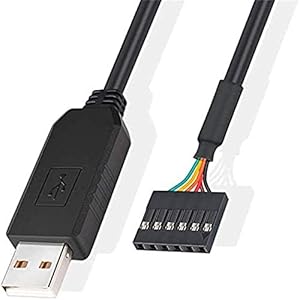
A serial adapter for electronics debugging, DTECH FTDI USB to TTL Serial Adapter, provides straightforward USB-to-UART communication for laptops and test benches. Hobbyists and engineers gain confidence when flashing firmware or monitoring serial consoles with clear pin access and driver support. Is this the right connector choice for projects that need native 3.3V logic and FTDI compatibility?
⚡ At a Glance
- • Signal Compatibility: Native 3.3V UART data signals with a 5V VCC power line and six-way outputs including RTS# and CTS#
- • Best for: Engineers, hobbyists and technicians working on router, GPS, set-top box and firmware flashing tasks
- • Not ideal for: Users who require automatic 5V TTL level shifting or a USB-C connection
Genuine FT232RL USB-to-UART chipset sits in a USB 2.0 Type A male terminal. A six-pin 0.1" pitch female header exposes Tx, Rx, RTS#, CTS#, VCC (5V) and GND with configurable EEPROM options.
Reliable Serial Communication – Thanks to Genuine FT232RL Chip
Genuine FT232RL USB-to-UART converter on the PCB provides stable USB 2.0 communication and recognised driver support. Configurable internal EEPROM allows Vendor ID rewrites and inversion of UART signals where required.
Stable serial links reduce connection and driver headaches when flashing firmware or accessing console logs. Fewer unknowns during field work improves turnaround on repairs and development tasks.
Safe 3.3V Hookups – With Six-Way 3.3V Data and 5V Power Outputs
Data lines operate at a 3.3V logic level while a separate VCC line supplies 5V power, with pinned outputs for Tx, Rx, RTS# and CTS#. A 6-pin 0.1" pitch female socket matches common header spacing on development boards.
Direct connection to 3.3V boards avoids external level shifters and reduces risk of damaging sensitive UART interfaces. Quick, correct wiring makes bench testing and device programming faster.
Wide System Compatibility – With USB 2.0 Type A Interface and Driver Support
USB 2.0 Type A male connector uses the FTDI chipset broadly supported by Windows, MacOS and Linux kernels (product notes list Windows 10/8/7, various legacy Windows versions, MacOS and Linux 2.4+). User feedback also confirms operation on Windows 11 and Linux.
Works across laptops and lab machines without special adapters, simplifying on-site diagnostics and development. Cross-platform support keeps toolchains consistent between colleagues and test rigs.
✨ The 4 Key Reasons for DTECH FTDI USB to TTL Serial Adapter
- Genuine FT232RL chip – Ensures stable USB-UART conversion with reliable data rates
- Six-foot cable – Allows comfortable bench-top access and reaching nearby devices
- Configurable EEPROM – Enables Vendor ID rewrites and UART inversion for flexible setups
- Colour-coded connectors and pinout wallet – Speed up accurate connections and reduce wiring mistakes
📋 Technical Details at a Glance
- Category: Electronics - Serial adapter cable
- Chipset: Genuine FT232RL USB-to-UART converter
- Interface: USB 2.0 Type A male
- Logic level: 3.3V data signal, VCC provides 5V power
- Outputs: Tx, Rx, RTS#, CTS#, VCC, GND (6-way)
❓ Frequently Asked Questions
Q: Does the adapter use 3.3V logic or 5V?
A: Data signals are at 3.3V logic while the VCC line supplies 5V power, allowing safe connections to 3.3V UART circuits without level shifting.
Q: Which operating systems are supported?
A: FTDI chipset compatibility covers Windows (including Windows 10 and earlier versions listed), MacOS and Linux 2.4 or later; user feedback also confirms use on Windows 11 and Linux.
Q: Is level shifting required for 3.3V devices?
A: No additional level shifting is required for 3.3V UART targets because the data lines operate at 3.3V.
🏆 Our Verdict
Ideal for electronics hobbyists, firmware engineers and network technicians who need dependable USB-to-serial access. Native 3.3V signalling, a genuine FT232RL chipset and a six-way header make the adapter particularly useful for flashing, debugging and console access. While cost varies, the cable represents practical long-term value for anyone who frequently works with UART interfaces.
