





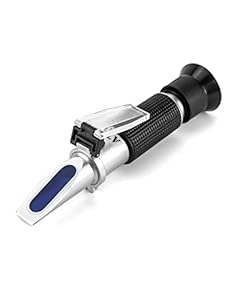
Kitchen measuring tool for sugar content testing, promising quick and reliable Brix readings. Home brewers and gardeners will feel confident tracking fermentations and ripeness with QWORK Brix Refractometer. Is it a practical choice to include in a regular testing kit?
⚡ At a Glance
- • Measurement Range: 0–32% Brix, suitable for most fruit and beverage sugars
- • Best for: Home brewers, juice makers and gardeners checking ripeness
- • Not ideal for: Testing honey, which the device cannot measure
Optical refractometer measures sugar content from 0 to 32% Brix with automatic temperature compensation. Clear blue-white scale and adjustable eyepiece make manual readings straightforward.
Accurate readings across temperatures - with Automatic Temperature Compensation (ATC)
ATC compensates for temperature-related shifts in refractive index, adjusting the optical reading so the Brix value remains accurate without manual correction. The mechanism works across typical kitchen and cellar temperatures to reduce variance.
More reliable sugar measurements whether testing chilled juice or warmer mash samples. Fewer repeat measurements save time during frequent checks.
Fast results from tiny samples - with 2-3 drop sample requirement and optical scale
Light passes through the small liquid sample and refracts onto a calibrated scale, visible through an adjustable eyepiece. Clear demarcation lines produce an immediate optical reading without complex setup.
Get a reading in seconds using only 2-3 drops, ideal for quick checks during brewing or fruit harvest. Minimal waste and rapid turnaround suit busy kitchens and small-batch brewers.
Useful for brewing and juice testing - with 0-32% Brix range and optical ABV estimation
The 0–32% Brix span covers common sugar concentrations in wines, beers and fruit juices, and optical readings can be used alongside fermentation calculations to estimate alcohol potential. User reports indicate optical ABV readings up to about 15%.
Makes it practical to monitor fermentation progress and to compare ripeness between fruit samples. Not designed for honey analysis, so stick to suitable liquids like juice and wort.
✨ The 4 Key Reasons for QWORK Brix Refractometer
- Automatic Temperature Compensation - Ensures accurate Brix readings across typical sample temperatures
- Small sample volume - Only 2-3 drops required, giving quick readings for each sample
- Clear demarcation lines - Blue-white scale improves visibility under normal daylight conditions
- Ergonomic scoop design - Durable shape helps apply samples neatly without spills
📋 Technical Details at a Glance
- Category: Kitchen
- Brand: QWORK
- Model: Brix Refractometer
- Measurement Range: 0–32% Brix
- Sample Volume: 2–3 drops
❓ Frequently Asked Questions
Q: Can the refractometer test honey?
A: No, the device cannot be used to test honey, as stated in the product description.
Q: How much sample do I need for a measurement?
A: Only 2-3 drops of liquid are required to get an accurate optical reading using the refractometer.
Q: Is it suitable for brewing and wine testing?
A: Yes, the 0–32% Brix range is suitable for wine, beer and fruit juices, and users report being able to get optical ABV readings up to about 15%.
🏆 Our Verdict
Ideal for home brewers, juice makers and gardeners who need quick, repeatable sugar readings. Automatic temperature compensation combined with a small sample requirement and clear optical scale makes routine testing straightforward. Offers practical long-term value for regular testers who want dependable manual Brix readings without complex equipment.
